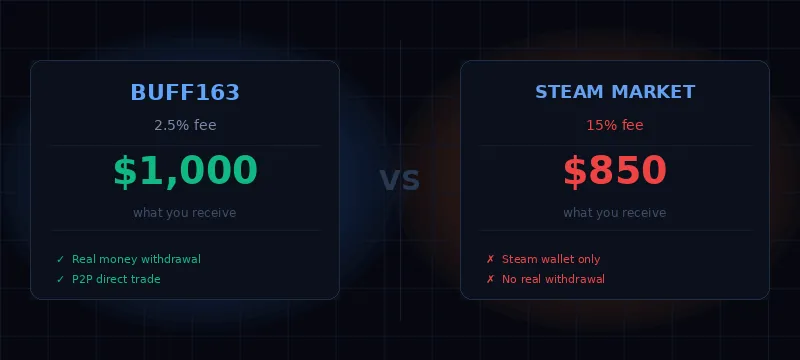
Buff163 vs Steam Market: Which CS2 Prices Are Real?
If you've ever wondered why your CS2 inventory looks different on different platforms, the answer is one word: fees. Steam Market and Buff163 both show prices for the same skins, but they reflect fundamentally different things — and confusing them can cost you real money.
What Is Steam Market?
The Steam Community Market is Valve's first-party marketplace integrated into the Steam client. Every transaction carries a 15% fee: 5% to Steam and 10% to the game's developer (Valve, in CS2's case). That fee is baked into the listed price — so when you see an AWP Dragon Lore listed at $1,500, the seller actually receives $1,275 in Steam credit. Not cash. Not money you can withdraw. Steam credit that can only be spent on Steam.
This creates two compounding distortions. First, sellers have to list higher to compensate for the fee, artificially inflating visible prices. Second, because the proceeds are Steam-wallet-locked, many sellers accept lower real-world prices on alternative platforms rather than list on Steam at all. The result: Steam Market is a closed economy that systematically overstates skin values relative to real cash.
What Is Buff163?
Buff163 (buff.163.com) is China's dominant CS2 skin marketplace, handling an estimated 60–70% of all CS2 P2P skin volume globally. It operates as a peer-to-peer exchange: sellers list skins, buyers purchase directly, and Buff charges approximately 2.5% on each transaction. Crucially, sellers can withdraw their proceeds as real money — RMB, converted to USD or EUR via standard methods. This makes Buff163 prices a genuine reflection of what traders worldwide are willing to pay in cash for a skin at this moment.
The Real Price Difference
The spread between Buff163 and Steam Market for the same skin typically runs 12–18% for liquid items — directly corresponding to Steam's fee overhead. For illiquid or high-value items (StatTrak knives, rare patterns), the spread can exceed 25% because Steam Market depth is thin and sellers price for the fee-adjusted exit.
A practical example: an AK-47 Redline Field-Tested that shows $28 on Steam Market will typically show $23–24 on Buff163. That 15–20% difference isn't market inefficiency — it's the cost of Steam's closed economy.
Why CS2 Investors Use Buff163 as Their Benchmark
Professional CS2 skin investors treat Buff163 prices the same way stock traders treat exchange prices — as the authoritative real-time market reference. Here's why:
- Withdrawal-based pricing: Buff163 prices reflect what you can actually extract as cash.
- Deepest global liquidity: More buyers and sellers than any other P2P platform means tighter spreads and more accurate price discovery.
- No wallet lock-in: Steam Market prices are distorted by the fact that Steam credit has lower utility than cash for many sellers.
- ROI accuracy: If you buy a skin off Buff163 and sell it back there, your P&L is the Buff163 price delta minus 5% (2.5% buy + 2.5% sell). That's a clean, accurate ROI calculation.
How CS Gain Uses Buff163 Prices
CS Gain fetches live Buff163 prices via PriceEmpire's data feed, updating your portfolio value in real time. When you set a buy price for each skin, the P&L and ROI calculations are always based on Buff163 — because that's the number that actually matters for investment tracking. You can switch to Steam, Skinport, or CSFloat pricing for comparison, but Buff163 is the default because it gives you the most accurate picture of your real net worth in CS2 skins.
If you're serious about tracking your CS2 skin investments — not just watching pretty price graphs but understanding your actual returns — you need Buff163 prices. Everything else is theater.