CS2 Skin Arbitrage: How to Find Price Gaps Between Skinport and Buff163
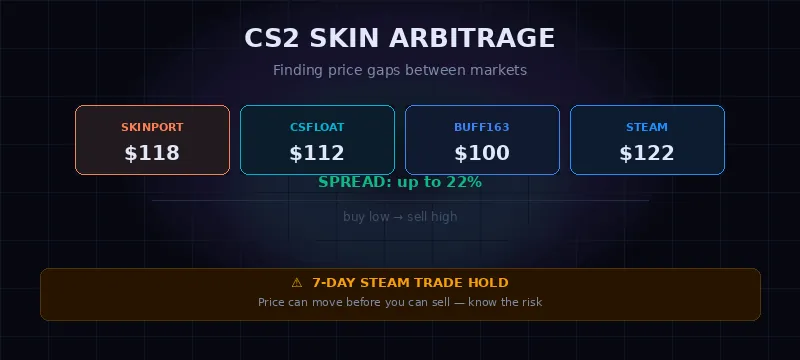
Every CS2 skin exists on multiple marketplaces simultaneously — and almost never at the same price. A skin listed at $100 on Buff163 might clear for $112 on Skinport and $118 on the Steam Market. The spread exists because each platform has a different buyer pool, different fee structure, different regional access, and different levels of trust and friction. Where there is a spread, there is a theoretical arbitrage opportunity — buy on the cheaper platform, sell on the more expensive one.
In practice, CS2 arbitrage is more constrained than it sounds. The 7-day Steam trade hold is the central constraint that transforms what looks like a risk-free spread into a genuine directional bet on prices holding for a week. Understanding exactly how that changes the calculus — and where the real opportunities still survive — is what separates traders who profit from this from those who lose money trying.
The Marketplace Landscape: What You Are Actually Comparing
Before identifying spreads, you need to understand what each platform actually is — its fee structure, its buyer pool, its geographic reach, and its friction. The differences between platforms are large enough that the same trade looks completely different depending on which direction you run it.
| Platform | Fee (seller) | Fee (buyer) | Real-money withdrawal | Geographic reach | Trade hold | Liquidity tier |
|---|---|---|---|---|---|---|
| Buff163 | 2.5% | 0% | Yes (CNY, bank/Alipay) | China-primary (VPN required for most Western users) | None (P2P direct) | Very High |
| Skinport | 6–12% (tier-based) | 0% | Yes (PayPal, bank, crypto) | Global | 7 days (Steam) | High |
| CSFloat | 2% | 0% | Yes (crypto, bank) | Global | 7 days (Steam) | Medium-High |
| Tradeit.gg | Varies (trade bots) | Markup on item value | Credits + limited cash-out | Global | Near-instant (bot trade) | Medium |
| Steam Market | 15% (5% Steam + 10% Valve) | 0% | No (Steam wallet only) | Global | 7 days (first-time) | Very High |
The most important column is real-money withdrawal. Steam Market proceeds are locked in your Steam wallet — permanently. Every other platform on this list lets you extract real money. This distinction alone explains why Buff163 and Skinport prices are lower than Steam Market for equivalent skins: sellers on those platforms are actually getting paid, not accumulating store credit.
Where the Arbitrage Spreads Actually Come From
Cross-platform price gaps are not random noise. They have structural causes that persist over time:
- Geographic friction. Buff163 requires a Chinese account, Chinese payment methods, and comfort operating on a Chinese-language platform with a VPN from most Western locations. This access friction means Western sellers cannot easily list on Buff163, reducing supply there relative to global demand — which keeps Buff163 prices for some skins below what they'd be if Western sellers had frictionless access. Meanwhile, Skinport is entirely accessible to European and American users, creating stronger supply-side competition and tighter margins.
- Fee pass-through. Skinport's seller fee (6–12% depending on volume tier) is partially visible in listing prices. Sellers who want a specific net amount will list higher to cover the fee. Buff163's 2.5% fee creates far less upward pressure on listing prices. The gap between the two platforms on high-value items routinely reflects this 7–10% fee differential almost exactly.
- Liquidity premium and discount. Skinport buyers get items quickly via Steam trade offer. Buff163 buyers — particularly non-Chinese users — face more friction in the transaction process. Buyers who value speed and simplicity pay a premium on Skinport. Buyers willing to accept friction get a discount on Buff163. This is a real, persistent pricing signal.
- Information asymmetry. Buff163 is not widely monitored by Western traders in real time. When a new skin releases or a price moves sharply, there can be a lag of hours before Buff163 pricing adjusts to match Skinport or CSFloat. Experienced traders watch all markets simultaneously to catch these windows.
The 7-Day Trade Hold: The Constraint That Changes Everything
Every skin you purchase on Skinport, CSFloat, or any Steam-based marketplace comes with a 7-day Steam trade hold before it can be traded or sold again. This is a Valve policy applied to all trades involving items that have recently changed hands via the Steam trading system. It is non-negotiable and cannot be bypassed.
This single constraint converts CS2 skin arbitrage from a theoretically risk-free spread trade into a 7-day directional position on price. Here is exactly what can go wrong in that week:
- Market-wide price correction. CS2 skin prices respond to news: a major update, a new case release, a ban wave, a streamer's inventory being compromised. If you buy a $200 skin to sell for $220 and the market drops 15% during your trade hold, you exit at $170 — a $30 loss on a trade you entered expecting a $20 gain.
- Specific skin repricing. The skin you bought might get added to a new collection, a cheaper variant might release, or the demand that created the spread might simply evaporate. Seven days is a long time in a market driven by trend and sentiment.
- Platform spread compression. The spread that looked attractive when you bought might disappear by the time your hold expires. Other traders seeing the same opportunity can flood supply on the higher-priced platform, compressing the premium before you can benefit from it.
- Fee erosion. A 12% spread between Buff163 and Skinport sounds attractive. After Skinport's 6% seller fee, your net spread is 6%. After factoring in the currency conversion cost (Buff163 pays in CNY), potential VPN costs, and the time cost of managing the transaction, the effective margin can compress to 2–3% — which needs to survive 7 days of price risk to yield a profit.
The professional framing is this: CS2 arbitrage is not a spread trade, it is a leveraged directional bet with a time-limited exit window. Treat it accordingly.
How to Actually Find the Spreads
Identifying an actionable spread requires comparing prices across platforms in real time for the same item in the same condition. The key tools and methods:
- PriceEmpire / CS Gain. PriceEmpire aggregates prices from Buff163, Skinport, CSFloat, and Steam Market into a single view. CS Gain uses PriceEmpire's Buff163 feed as the benchmark — the same data. Toggle between price sources in CS Gain to see the cross-platform spread on any skin in your portfolio instantly.
- Direct platform comparison. For high-value targets, check the actual Buff163 listing (not the aggregated data, which can lag) against the live Skinport order book. Look at the lowest ask on each platform for the same float range — not just the average price.
- Float-adjusted comparison. A skin at 0.14 float (near-MW boundary) on Buff163 and a skin at 0.08 float on Skinport are not the same asset. Compare like float ranges. The float premium on Buff163 is often more efficiently priced than on Skinport because Buff163's user base is more technically sophisticated about float valuation.
- Volume filter. Arbitrage spreads on illiquid skins are dangerous — the price you see might represent one or two listings, not a market. Target skins with at least 10+ listings on both platforms and daily transaction volume you can verify. The AK-47 Redline, AWP Asiimov, and M4A4 Howl tier items have enough volume for the spread to mean something.
The Skinport–Buff163 Spread in Practice
The typical spread between Buff163 and Skinport on a liquid mid-tier skin (Field-Tested Classified, $50–$150 range) runs 8–14% in normal market conditions. On high-value items ($500+) the spread often compresses to 5–8% because more sophisticated capital chases those opportunities efficiently. On niche or illiquid items the spread can appear much wider — but the illiquidity itself is usually the reason, not a genuine arbitrage opportunity.
After Skinport's 6% seller fee, the net executable spread on a mid-tier skin is typically 2–8% before accounting for the 7-day price risk. Whether that margin justifies the hold period is a risk-reward judgement you have to make based on how stable you believe that specific skin's price to be over the next week.
The most consistently actionable Skinport–Buff163 spreads tend to appear immediately after a major CS2 update or case release — when Buff163 prices lag in adjusting to Western market sentiment — and in the 48-hour window around a CS2 Major, when tournament-related demand spikes on Western platforms before Buff163 catches up.
How CS Gain Helps You Track Spread Positions
If you run cross-market positions, tracking them manually is error-prone. CS Gain's buy price feature lets you log your acquisition cost (including the Buff163 price in USD equivalent) and track your position against the current Skinport-equivalent price in real time. The P&L display shows you at a glance whether the spread has widened or compressed since you entered. The portfolio history chart gives you a clean record of position performance over time — useful for evaluating whether cross-market trading is actually profitable for you after accounting for all the factors discussed above.