The CS2 Skin Market in 2026: What's Actually Happening
The CS2 skin market in 2026 looks nothing like the speculation frenzy that followed the September 2023 engine migration. That period — marked by panic buying, inventory dumping, and price volatility that swung 30–40% in weeks — has given way to something more interesting from an investment perspective: a market with clearer fundamentals, stronger segmentation, and identifiable trends that reward informed holders over short-term flippers.
What follows is an honest read of the current situation based on Buff163 price data, trading volume patterns, and the structural shifts that have reshaped CS2's skin economy since the launch settled.
The Post-Launch Correction Is Complete
The 2023 CS2 launch caused a two-stage market event: first, a rally on anticipation, as traders bought into the upgrade narrative. Then a correction, as the reality of the new engine — lower FPS for many users, temporary feature regression, delayed case unlocks — disappointed some of the player base. From late 2023 through mid-2024, mid-tier skin prices (Restricted and Classified, $30–$150) fell 15–25% from their pre-launch peaks on Buff163.
That correction is now complete. The mid-tier has stabilised. More importantly, the players who left during the rough launch period have largely returned — CS2's monthly active players have recovered and the Steam concurrent player record has been broken multiple times since Q4 2024. More players means more case openings, which means sustained demand for skins at all price tiers.
High-End Skins Have Outperformed Everything
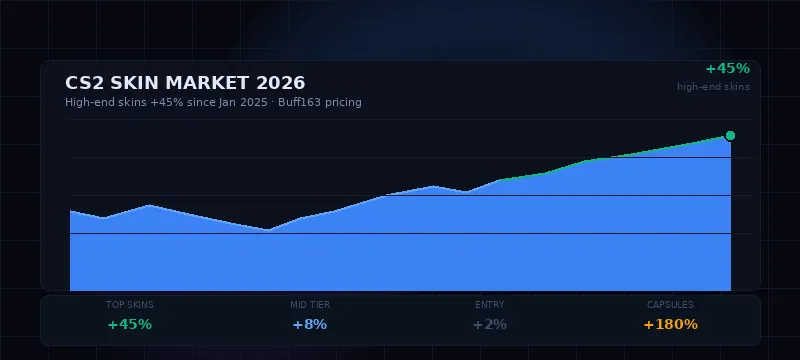
The most significant story of 2025–2026 is the sustained outperformance of the top of the market. Covert skins, rare patterns, low-float Factory New items, and high-end knife/glove combinations have appreciated 20–45% on Buff163 since January 2025, well ahead of the mid-tier and entry-level segments.
Several structural reasons explain this:
- Supply is finite and shrinking. Top-tier skins cannot be reprinted. Every AWP Dragon Lore that gets gifted to a new account, every StatTrak knife that gets used without care and accumulates kills, every rare-pattern skin that changes hands and loses its clean history — these reduce the quality supply permanently. The total number of clean, documented, low-float top-tier items decreases over time while demand grows with the player base.
- Real-money marketplaces have matured. The rise of vetted P2P platforms — Buff163, CSFloat with float inspection, Skinport with buyer guarantees — has made it easier for serious money to enter the market with confidence. Institutional-scale buyers (trading companies, investment groups treating CS2 skins as an alternative asset class) have become a real factor in high-end price discovery.
- The CSGO-to-CS2 inventory migration preserved item histories. A Dragon Lore from 2017 carries its full provenance in the Steam trade history. Buyers of legacy items get not just the skin but the story — a verifiable record of previous ownership, sometimes including famous players or notable crafters. This provenance premium is new in 2025 and is accelerating.
The Middle Market: Stable but Unexciting
The Restricted-to-Classified price range ($20–$200 on Buff163) is the most liquid segment and the most boring from an investment standpoint. These are the skins that most players buy, most traders flip, and most case openings are chasing. Price discovery here is efficient — arbitrage windows close quickly, and price manipulation attempts by bots are visible and short-lived.
For investors, the mid-tier is a trading segment, not a holding segment. The skins here are subject to direct competition from new case releases. When Valve releases a new case with a new AK-47 Covert, the existing popular AK-47 skins face substitution pressure. The mid-tier should be treated as inventory to turn over, not treasure to hold.
Cases: What the Opening Data Says
Case prices are the canary in the coal mine for overall market health. When players are actively opening cases, unbox fever drives up both case prices (from anticipation) and key prices (from demand). When sentiment is weak, case prices compress and keys trade near floor. As of May 2026, the case market shows:
- Legacy cases (Weapon Case, eSports 2013, Operation Bravo) have appreciated 30–50% since 2024 as supply decreases and collector demand grows. These cases can no longer be obtained through normal gameplay — they are purely secondary market items.
- Operation cases from 2014–2018 show similar but less dramatic appreciation. The Operation Hydra case and Operation Broken Fang case have both moved up 20–35% as operation collections remain permanently discontinued.
- Recent cases (released 2023–2026) trade near key price in the secondary market, reflecting adequate supply. The investment thesis for new cases requires patience — their appreciation cycle typically takes 3–5 years as supply is absorbed through openings.
Sticker Capsules: The Sleeper Asset Class
The single most underappreciated segment of the CS2 market in 2026 is sealed sticker capsules from Major tournaments between 2014 and 2019. These capsules were sold for $0.99–$3.00 at the time of each tournament and contain stickers from the competing teams. Several factors make them compelling:
- Supply is permanently fixed — no more are being created. Every capsule that gets opened reduces supply.
- Open rates have been declining as holders recognise the sealed premium over opened stickers.
- The sticker craft ecosystem — players applying rare stickers to skins — creates steady, permanent demand that consumes supply from both the sticker and capsule side.
The Katowice 2014 capsules (both normal and souvenir) have appreciated more than 10,000% since release. Even 2018 and 2019 Major capsules have seen 200–500% returns for long-term holders. For new investors looking for asymmetric upside with a multi-year horizon, sealed capsules from 2015–2020 remain an undervalued entry point relative to their trajectory.
What to Watch for the Rest of 2026
Three catalysts have the potential to materially move CS2 skin prices before year-end:
- PGL CS2 Major (expected Q3 2026). Every Major creates immediate demand for the competing teams' sticker capsules and souvenir packages — prices on current-year team stickers spike 48–72 hours before and during the event, then correct. The longer-term effect is adding a new data point to the legacy sticker market as today's team stickers become tomorrow's collectibles.
- Potential new Valve feature drops. CS2 is still missing features from the CSGO era — Danger Zone, Overwatch, Arms Race. If Valve ships a major feature update, the resulting player influx drives a broad market rally within 1–2 weeks. These events are unpredictable in timing but reliably positive for prices.
- Continued real-money market maturation. The professionalization of CS2 skin trading — better data, better tooling, more institutional participants — compresses spreads and improves price discovery. This is a slow, structural tailwind for the top of the market.
Using CS Gain to Navigate 2026
The clearest advantage for a portfolio-aware investor in 2026 is information density. CS Gain pulls live Buff163 prices, tracks your buy price against current market value, and shows how your portfolio has moved over time — the three data points that let you evaluate whether to hold, trim, or add to any position. The public leaderboard shows how your portfolio compares to other serious CS2 investors. In a market with clear segments behaving differently, knowing exactly where you stand is not optional — it's the edge.