What Determines a CS2 Skin's Price? The Complete Breakdown
Walk into any CS2 skin forum and you'll find the same question repeated endlessly: why is this skin worth so much more than that one? They look nearly identical. Same weapon, same finish. But the price is 8× higher. Understanding why is the difference between buying a skin for $180 that's worth $180 and buying one for $180 that's worth $320 to the right buyer. These are the five factors that determine CS2 skin prices — ranked by impact.
1. Rarity and Supply: The Foundation of Every Price
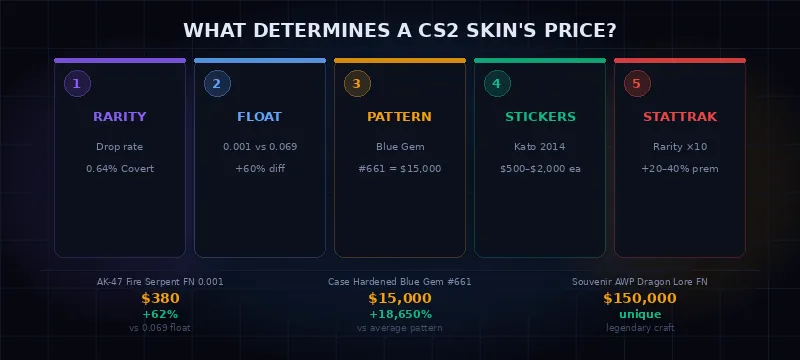
Every CS2 skin has a rarity tier: Consumer Grade (grey), Industrial Grade (light blue), Mil-Spec (blue), Restricted (purple), Classified (pink), Covert (red), and the separate Contraband tier (orange, one skin exists). These tiers determine how often a skin drops from a case. Covert skins drop at roughly 0.64% — about 1 in 156 case openings. Consumer Grade skins drop in nearly every case. Supply is the ceiling on price.
But rarity alone is not price. A rare skin from a dead case series that nobody cares about is cheap. A Mil-Spec skin from a popular collection with an iconic design can be expensive. Rarity × Demand = price floor. Both variables must be present. The AK-47 Asiimov is a Classified skin — only one tier below Covert — yet it commands prices near many Coverts because it's one of the most recognised CS2 designs in the world. Community desirability multiplies rarity.
2. Float Value: The Most Misunderstood Factor
Every CS2 skin has a float value — a number between 0.000 and 1.000 that determines exactly how worn the skin looks. Float is divided into five wear tiers: Factory New (0.00–0.07), Minimal Wear (0.07–0.15), Field-Tested (0.15–0.38), Well-Worn (0.38–0.45), and Battle-Scarred (0.45–1.00). The displayed wear tier is just a label — the raw float number is what serious buyers care about.
Within each tier, float creates enormous price spreads. A Factory New AK-47 Fire Serpent with a float of 0.001 (near-perfect) can sell for 40–60% more than the same skin at 0.069 (still technically FN but visibly more worn). For collector-grade skins, floats below 0.01 — sometimes called "blue gem float range" — attract dedicated collectors willing to pay extreme premiums. A StatTrak AWP Dragon Lore FN at float 0.006 and one at float 0.065 look different enough that screenshots immediately reveal the gap.
The key insight for investors: the best floats appreciate faster than the average float during price rallies, and hold value better during corrections. Buying mid-tier floats is fine for trading volume. Buying top-tier floats is better for long-term holds.
3. Pattern Index: Where the Real Premiums Hide
Some CS2 skins use a procedural pattern applied over a template, and the pattern index (a number from 1–1000 assigned at item creation) determines exactly how that pattern is placed. For most skins the pattern index is irrelevant — the variation is barely visible. For a small category of skins, the pattern index is everything.
The classic examples: Case Hardened (Blue Gem) — the AK-47 Case Hardened pattern #661 and #670 are near-solid blue on the magazine and body, making them worth 20–50× more than average Case Hardened floats. The same skin at a grey-heavy pattern might sell for $80; a top blue gem sells for $15,000+. Fade skins — the Butterfly Knife Fade pattern index determines how much purple versus pink versus gold appears; full fade (100%) commands a 30–50% premium over partial fades. Marble Fade — the Fire & Ice pattern (pure red/blue/white, no yellow) on the Karambit trades at 3–4× the average Marble Fade price.
Pattern premiums are pure collector value — they cannot be quantified by standard pricing tools. A site that shows "Karambit Marble Fade: $950 average" is giving you the average price across all patterns. The Fire & Ice version of that same skin sells for $2,800+. Always check the pattern before buying anything with variable geometry.
4. Sticker Value: The Hidden Multiplier
Stickers applied to a skin can add zero value or enormous value depending on three things: which tournament, which player, and condition. Katowice 2014 holofoil stickers — from CS:GO's first major — are the most valuable, with single stickers worth $500–$2,000 each. A skin with four Katowice 2014 holos in pristine condition can be worth more than the skin itself times 10.
The calculation traders use is: craft value = sum of (current sticker price × 0.25) — meaning a skin with stickers worth a combined $1,000 should trade at roughly a $250 premium above the base skin price. The 25% multiplier is a loose market norm, not a rule; high-demand crafts with story appeal (a famous player's signature on their signature weapon) can achieve 40–60% of sticker value.
For investors: stickers from Major events (ESL One Katowice, PGL Antwerp, IEM Cologne) hold value better than non-Major paper. Holo and gold stickers hold better than regular paper. Player autographs of retired or deceased professionals (Flusha, NiKo in his peak Cloud9 era, s1mple) appreciate over time as the legend grows and no new stickers are produced.
5. StatTrak and Souvenir: The Variant Premium
StatTrak skins track kill counts on the weapon and are distinguished by an orange kill counter on the weapon model. They are rarer — dropping at roughly 10% the rate of standard versions — and consistently command a 20–40% price premium over non-StatTrak equivalents for popular skins. For ultra-rare skins (AWP Dragon Lore, AK-47 Wild Lotus), the StatTrak premium can reach 100%+ because the low base supply combined with 10% StatTrak odds means very few StatTrak versions exist.
Souvenir skins drop from Major tournament capsules and feature four applied stickers — two team stickers, one player autograph, and a tournament gold sticker. They cannot be StatTrak. For most skins, the souvenir variant is less valuable than the crafted equivalent. The exception: Souvenir AWP Dragon Lore, particularly from early Majors with legendary matchup stickers (NaVi vs Virtus.pro, for example), is the single most valuable class of item in CS2. A Souvenir AWP Dragon Lore FN from DreamHack 2014 with correct stickers has sold for over $150,000.
How to Use These Factors to Invest Smarter
The investors who consistently outperform the average CS2 market do so by combining two or more of these factors in a single purchase. A skin with low float + rare pattern + strong sticker craft is not priced at the sum of those premiums — it's priced at the intersection, which is often below fair value because average buyers don't recognise all three simultaneously. That's the arbitrage opportunity. CS Gain tracks your buy price against current Buff163 market value so you can see exactly how each factor is being priced by the market at any moment.