Why Are CS2 Skin Prices Falling? 2026 Market Crash Explained
If your inventory value has been bleeding for months, it's not just you. CS2 skin prices have been falling across almost the entire market in 2026, and the November numbers show no clean bottom yet. The sentiment among traders, collectors and even pro players is the worst it has been since the CS:GO-to-CS2 migration.
This article breaks down why CS2 skins are going down, from Valve's knife and glove trade-ups to the new Steam Community Market, the loot box lawsuits, and the liquidity drain. It also looks honestly at a popular theory: that Valve is pushing prices down to pull traders back from third-party markets onto Steam.
How bad is the CS2 skin market in November 2026?
Every major tracker points the same way, even if the exact numbers differ:
- Total market value: CSMarketCap puts the CS2 item economy at roughly $5.2 billion on November 8, 2026. That is down about 8.6% in 30 days and roughly 40% below its all-time high.
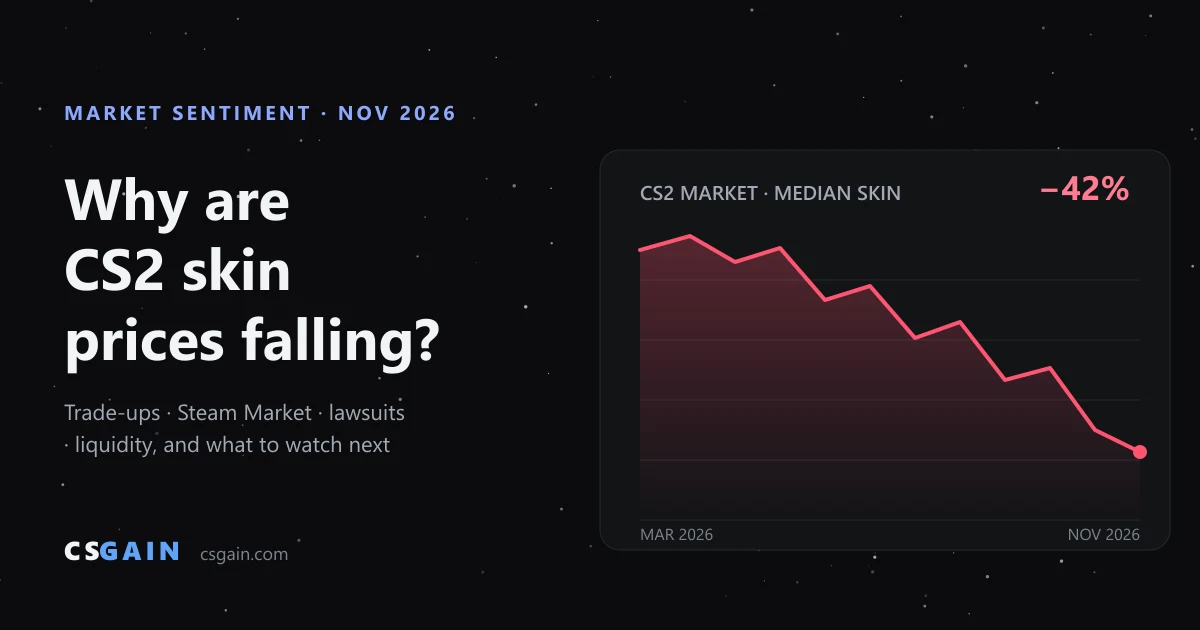
- Breadth of the decline: CSDB compared 1,185 skins between March 2 and November 8, 2026. The median skin lost 41.9%, and 99% of skins fell. Only 7 of the 1,185 rose by more than 1%.
- Knives and gloves: a year after Valve's trade-up update, the cheapest knives and gloves are trading at the lowest monthly prices in their Steam history, which goes back to 2018 (CGMagazine, November 2026).
| Category | Median change (Mar 2 → Nov 8, 2026) | What's driving it |
|---|---|---|
| Gloves | −46.6% | New supply from Covert trade-ups |
| Knives | −45.6% | New supply from Covert trade-ups |
| SMGs | −41.6% | Broad sell-off, low liquidity |
| Pistols | −38.8% | Broad sell-off |
| Rifles | −37.7% | Partly supported by trade-up demand |
| Heavy | −37.0% | Broad sell-off |
Source: CSDB market trends. The few skins that went up are mostly older items from discontinued collections. That pattern matters, and we come back to it below.
Reason 1: The knife and glove trade-up broke the scarcity story
On October 22–23, 2025, Valve allowed players to trade five Covert skins for a knife or gloves from the same collection. Five StatTrak™ Coverts give a StatTrak™ knife; StatTrak™ inputs can't produce gloves. Before that, knives and gloves came almost exclusively from cases, at odds of about 0.26%.
The market reacted immediately. Estimates of the overnight loss range from about $1 billion to $2 billion in market cap, and some gloves lost up to 70% in a single day. The deeper damage was psychological. The "rare special item" was the anchor of CS2 skin investing, and it suddenly had a new, repeatable supply channel. Every trade-up since then adds another knife or pair of gloves to the market, and that ongoing supply is why the cheapest ones are still sliding a year later.
The underrated insight: trade-ups also created a price link between Covert skins and the knives and gloves they can produce. When a knife is worth less than the cost of five Coverts from its collection, nobody does that trade-up, and new supply slows. That link puts a soft floor under some knife and glove prices. It doesn't stop the decline, but it shapes where prices can settle.
Reason 2: Souvenir trade-ups and the Major shop changed supply again
With the IEM Cologne 2026 update (May 21–22, 2026), Valve allowed Souvenir skins in Trade Up Contracts. The output loses its Souvenir status. Valve also replaced souvenir package drops with the Souvenir-O-Matic, and Major stickers can now be bought directly at dynamic prices instead of through capsules.
Cheap souvenirs briefly spiked because they became trade-up fuel, but collectors read it as a second sign that Valve is willing to rewrite supply rules at any time. For the sticker and souvenir economy that depends on Majors, and on pro players and teams, it changed how scarcity is created.
Reason 3: Trade Protection made cash trading slower and riskier
Since July 2025, items received in a trade are protected for seven days. During that window the trade can be reversed, and a reversal locks the account out of trading and the Community Market for 30 days. Cash traders and many third-party platforms had to delay payouts until the window closed. Slower, riskier settlement means less active capital, and less capital means weaker bids.
Reason 4: The loot box lawsuits hang over cases
On February 25, 2026, New York Attorney General Letitia James sued Valve. The suit argues that CS2 cases, the Community Market and third-party cash-out services add up to illegal gambling. A separate federal class action seeks refunds for loot box purchases. Valve filed a motion to dismiss on May 18, 2026, comparing cases to trading card packs.
No ruling has been reported, but legal uncertainty is poison for long-term holders. If regulators restrict cases or cash-outs, the whole investment thesis changes. A dataminer has also claimed Valve is holding back new cases because of the lawsuits. That claim is unconfirmed, so treat it as rumor.
Reason 5: Fewer buyers and money leaving the market
- Player numbers are disputed. One analysis says monthly average players fell roughly 24%, from about 1.08 million in February 2026 to about 825,000 in August. Other sources claim monthly active users grew. Whichever is right, the market has been falling regardless of player counts. That points to a sentiment and liquidity problem, not just a demand problem.
- Liquidity is going elsewhere. Several traders interviewed by EsportFire point to strong crypto and stock markets pulling speculative money out of skins.
- The feedback loop. Falling prices trigger stop-loss selling, sellers undercut each other in thin markets, and the next dip arrives faster. That is classic bear-market behavior.
Is Valve pushing prices down to win traders back to Steam?
This theory is everywhere right now, and it deserves a serious look rather than a meme.
Evidence that fits the theory
- Steam rebuilt its market. On May 12, 2026, Valve rolled out a redesigned Steam Community Market. It added float values, pattern data, stickers and charms on every listing, and trading volume on the price graphs. Those are exactly the features that used to send traders to third-party sites.
- Steam has price ceilings. The Steam Community Market caps single listings at roughly $1,800, and older Valve guidance limits Steam Wallet balances to about $2,000. Expensive knives and gloves have always traded on third-party sites because they couldn't trade on Steam. When prices fall, more high-tier items fit under Steam's ceiling, and more trading happens on Steam.
- Trade Protection mainly hurts off-platform cash trading, not Steam Market purchases.
Evidence against it
- Valve earns a percentage. The seller fee is 15% (5% Steam plus 10% CS2). Lower prices mean less revenue per sale for Valve, so crashing prices only pays off if volume rises a lot.
- No per-buyer purchase limit. We found no official per-buyer purchase quota for CS2 items. The real limits are on listings and wallets, which is different from a "buy limit".
- The lawsuits are the simpler explanation. With regulators calling skins gambling, Valve has a strong legal reason to make skins less like investments: more accessible, less speculative, easier to obtain. That points to lower prices without any plan to take over the third-party market.
Our verdict: lower prices clearly help the Steam Market compete. Whether that is Valve's goal or a side effect of fighting speculation and legal risk can't be proven from the outside. The more useful question for your portfolio is whether Valve has more supply levers left to pull. The past twelve months suggest yes.
What this means for you
For players
Knives and gloves are the cheapest they have ever been on Steam. If you want a knife to use, not to flip, this market is on your side. Buy what you like at a price you'd still be happy with if it fell another 20%.
For skin traders
- Don't try to catch the exact bottom. In a 99%-declining market, timing a single bounce is gambling. Scale in gradually if you buy at all.
- Watch the trade-up math. Compare knife and glove prices with the cost of five Coverts from their collection. When knives trade below that cost, new supply dries up. That is one of the few hard signals this market has.
- Price gaps between markets get wider in panics. Spreads between Buff163, Skinport, CSFloat and Steam open up when sentiment collapses. See our Skinport vs Buff163 arbitrage guide.
- Discontinued items outperform. The few skins that rose since March are mostly from discontinued collections. Supply that Valve can't easily add to is still the strongest defense. Our Armory analysis covers this.
For pro players, teams and collectors
Major stickers and souvenirs now follow different rules: direct sticker purchases at dynamic prices, the Souvenir-O-Matic, and souvenir trade-ups. Expect more supply of cheap souvenirs and less of the "capsule lottery" premium. Rare legacy stickers and early-Major souvenirs are a different story: their supply is fixed, and they carry the most collector value.
Signals that would mark a real turnaround
- Knives trading below the cost of five Coverts for weeks, which means new supply has stopped.
- A clear court ruling in the New York or federal loot box cases.
- Player counts stabilizing through the usual late-year update season. Prices tend to follow players with a lag.
- Narrowing price spreads between Buff163 and Western markets, a sign the panic is easing.
- A Valve update that removes supply (discontinued drop pools, new sinks) instead of adding it.
Track the market with your own portfolio
Market-wide numbers hide what is happening to your items. On CSGAIN you can track any public CS2 inventory with live Buff163 and Steam prices, see 24h and 7d change per item, and follow your P&L against your buy prices. The CS2 portfolio leaderboard shows how the biggest inventories are moving, and the sentiment indicator on the homepage summarizes the market's direction in one glance. It's free, and all you need is your Steam ID.
FAQ: CS2 skin market 2026
Why are CS2 skins going down in 2026?
Several things are hitting the market together. The October 2025 knife and glove trade-ups added a permanent new supply channel. The May 2026 souvenir trade-ups changed supply again. Trade Protection slowed cash trading. Loot box lawsuits created legal uncertainty, and speculative money moved elsewhere. The median skin is down about 42% since March 2026.
Will CS2 skin prices recover?
Nobody can promise a recovery. Prices have historically followed player activity with a lag, and the late-year update season often brings new players. A lasting recovery needs supply to stabilize and the legal situation to become clearer. Until then, rebounds may be short-lived.
Is Valve crashing the CS2 market on purpose?
There's no proof. Lower prices help the redesigned Steam Market compete with third-party sites, because more items fit under Steam's price ceiling. But Valve earns a percentage of every sale, and the loot box lawsuits give Valve a simpler reason to make skins less speculative.
Should I sell my CS2 knives now?
That depends on your situation. If a further 20–30% drop would hurt you, reducing your exposure is reasonable. If you hold for the long term, watch the trade-up cost signal and focus on items Valve can't easily re-supply. This is not financial advice.
Is it a good time to buy CS2 skins?
For skins you want to use, prices are historically low. For investing, buy gradually rather than all at once. Prefer discontinued collections and items whose supply is fixed, and avoid items that trade-ups can keep producing.
Sources
- CSMarketCap: CS2 market cap and price index
- CSDB: CS2 skin market trends (Mar–Nov 2026)
- CGMagazine: A year after Valve's trade-up update, gloves and knives are still getting cheaper
- Esports News UK: Market loses value overnight after the knife trade-up update
- EsportFire: Why are CS2 skins going down? (trader interviews)
- Skinbase: Steam Community Market update, May 2026
- GosuGamers: Valve responds to the New York AG loot box lawsuit
- CSDB: CS2 Trade Protection explained